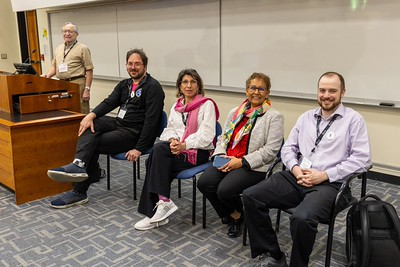
In the photo, left to right: John Koval, Jack Davis, May Raad, Charmaine Dean, James McVittie
Professional networking is an important development area for SSC accreditation which has a large diverse group of applied statistical practitioners who span academia through industry. The 2025 accreditation survey was used to identify topics of professional interest that were incorporated into the 2026 invited session about (1) data ethics training, (2) communication, (3) teamwork, and (4) differences between consulting and collaboration.
Jack Davis introduced the rationale for the SSC Code of Ethical Statistical Practice as a responsibility to society, to employers and to clients, to other statistical practitioners, and to professionalism. Upholding the code is mandatory for SSC accredited, and encouraged for all SSC members; yet data ethics is not usually taught in undergraduate university courses. He now introduces ethics training in a graduate course with a reading assignment in one of his regular classes (Stat 847: EDA): Dark Data: Why What You Don’t Know Matters, by David Hand; Data Ethics: Practical Strategies for Implementing Ethical Information Management and Governance, by Katherin O’Keefe; Data Science Ethics: Concepts, Techniques and Cautionary Tales, by David Martens; and, Data science ethics podcast https://datascienceethics.com. He spends half a lecture on ethics from Statistics Canada https://www.statcan.gc.ca/en/wtc/data literacy/catalogue/892000062022001 giving examples about residual disclosure and deanonymization, on colonial harm, and on protection for vulnerable groups. He also encourages data ethics training whenever appropriate in university courses with statistical computation and exploratory data analysis. He encourages others to consider opportunities to introduce discussions about statistical practice in their environments.
May Raad spoke about the versatility and breadth of experience needed to communicate best and the latest methods to objectively measure impacts of an agency’s operations, policies, or regulations in the engineering consulting industry and provide statistical and analytical insight and results for public and private clients across many sectors. Because of complexity of statistics coupled with (often) clients’ lack of training and knowledge in statistics, stronger communication skills are critical for statisticians to successfully explain complex concepts in accessible terms, listen to client needs, and clearly link analysis to practical outcomes. In addition, advanced communication skills can elevate the profession, build careers, and foster trust. The talk included recommendations for interdisciplinary training and business and economic awareness to bring statistics to the forefront of decision-making. May demonstrated through real client examples how effective communication skills led to impactful insights and repeat client engagements. During the question period of the talk, the topic of artificial intelligence’s impact on statistical consulting was asked. May reminded the audience that while AI is rooted in statistical principles, practitioners must clearly manage expectations and confidently position statistical methods as essential to solving modern problems and integrating new technologies.
Charmaine Dean discussed the importance of teamwork in interdisciplinary research in environmental sciences where collaborations with scientists, government agencies, and local site workers directly can develop a deeply multifaceted approach for team-based analyses. Dean emphasized that impactful applied statistics is inherently team-based and depends on effective collaboration across disciplines, sectors, and communities. She illustrated this through a wildfire management case, highlighting that real-world problems require integrating models, data, and expertise across domains, with statisticians playing a key role in coordinating knowledge rather than working in isolation.
Dean further argued that accreditation and professional readiness extend beyond technical skills to include communication, ethical practice, and the ability to build strong interdisciplinary relationships. While collaborative approaches face challenges, such as lack of shared language, competing incentives, and disciplinary silos, they ultimately enable innovation and more effective solutions to complex problems.
Finally, Dean outlined what some key features of successful collaboration looks like in practice: shared problem definition, respect for different expertise, iterative communication, and clarity in roles, and pointed to institutional, funding, and training mechanisms that can support large-scale interdisciplinary work in Canada.
Then, James McVittie concluded with transdisciplinary consulting and collaboration experience arising from a university statistical consulting group. He emphasized the importance of clearly defining upfront in a preliminary meeting the classification of work as a consultation for which a contract would cover prespecified goals and costs, or as a collaboration for which the nature of the project and authorship would be discussed. In both situations, upfront verbal and written communication are advisable for transparency; sample letters were provided. In particular, the consulting arrangement was cosigned and filed with the department head.
Lively discussions enhanced sharing of experiences and were continued at the accreditation social after the session. Slide decks are provided in the Accreditation professional development area of the SSC website.
John Koval, P.Stat. (090)
Jack Davis, PhD, P.Stat. (220)
May Raad, MSc, P.Stat. (158), PStat®
Charmaine Dean, PhD, P.Stat. (033)
James McVittie, PhD, P.Stat. (215)
Judy-Anne Chapman, P.Stat. (002)