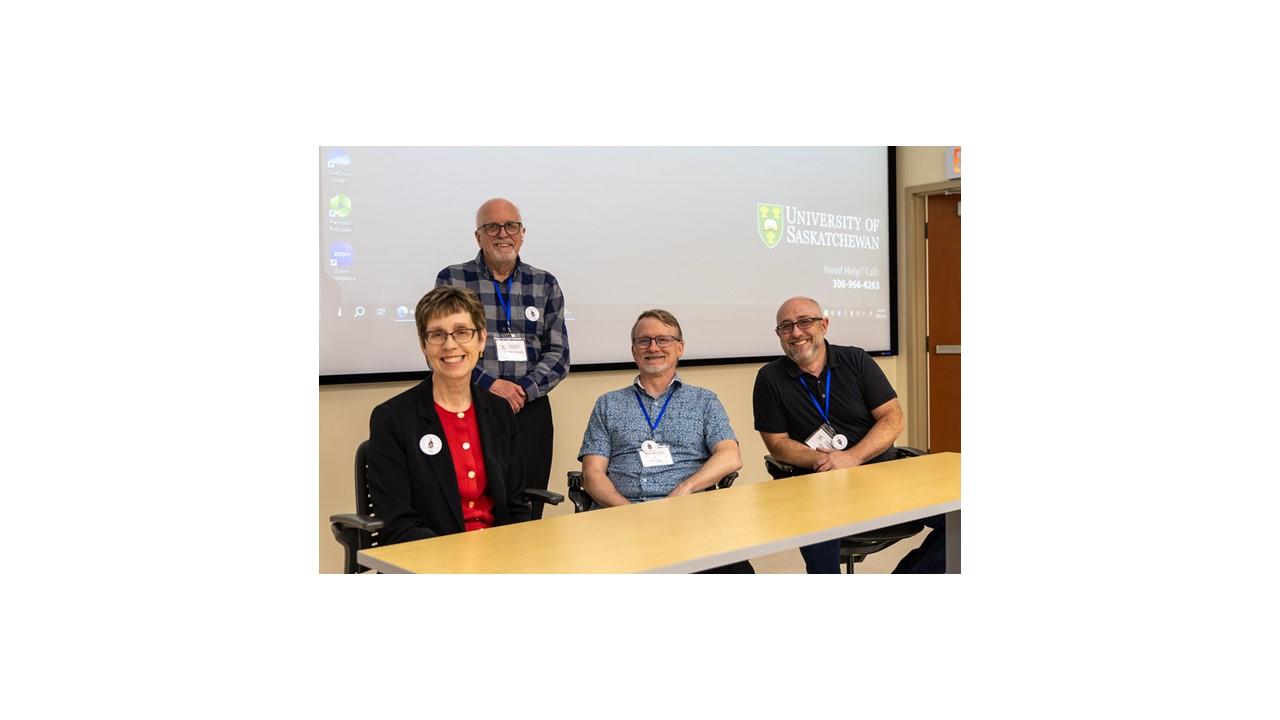
Networking is a core accreditation program area being developed by the accreditation services committee. An experienced panel of accredited Professional Statisticians (P.Stat.) shared decades of consulting experience and participated in lively interactions with attendees during and after the 2025 accreditation annual meeting session.
Lisa Lix talked about the data science team that she leads in the George & Fay Yee Centre for Healthcare Innovation at the University of Manitoba. She focused on three topics: (a) consulting in a rapidly changing environment, (b) thriving in an AI-driven world, and (c) ensuring that the client is at the centre of the consulting relationship. Her concluding remarks focused on the benefits of working in an academic consulting environment, importance of adapting to changes in the consulting environment, such as the use of large language models to develop software code, and the value of being equipped with a variety of skills, including equity, diversity, and inclusivity perspectives, data management, patient/public engagement, and communicating with diverse audiences.
Wesley Burr presented his experience in interdisciplinary collaboration, emphasizing the questions of what, who, where, when, why, and how. He began with a definition of what he considers to be the definition of interdisciplinary collaboration, under the theme of loving science and the scientific process of discovery. He emphasized that one reason to do collaborative consulting is that it can be genuinely enjoyable and fun—meeting scientists where they are, and helping them model their data and designs improves their science. In Wesley's remarks, he acted as a bridge, connecting Lisa’s remarks on client-driven consulting in a team environment with Tom’s remarks on communication with singular clients.
Tom Loughin leaned into his 30+ years of statistical consulting and collaboration experience to share concrete suggestions for improving communication with statistical partners. Translating between collaborator’s experience and language into statistical problem statements and models can be the most challenging part of a collaboration, yet it is least likely to be taught in classes. Tom recommended beginning the process with a simple, high-level conversation to get a lay overview of the partner’s goals and aspirations before trying to understand details of their present work. Asking questions directed by our expertise is, of course, an essential part of the process, but repeating back their answers in nontechnical language is a trick that can often prevent misunderstandings. And if someone ever tells you that they gathered data or applied treatments “at random,” dig into this—people outside of our discipline often do not appreciate the subtle statistical implications that accompany true randomness and use the word as a surrogate for many things that we would not consider “random.”
Applied statisticians frequently operate in sole statistical practices, or with only a few others. The opportunity to interact with others outside of their employment on both professional and personal levels has been the centrepiece for meetings of the Southern Ontario Regional Association (SORA), The Applied Biostatistics Association (TABA), and the Statistical Society of Ottawa.
Accreditation offers the opportunity for year-round (virtual) networking across Canada. The Accredited-only Mentoring and Networking database with individual professional backgrounds, interests, and experience has been used predominantly to help Associate Statisticians (A.Stat.) find a mentor. P.Stat. and A.Stat. are encouraged to search the lists for others with their specialties or in their regions to enrich their professional lives.
Slides for the session are found in the Accredited Professional Development area.
Lisa Lix, P.Stat. (051)
Wesley Burr, P.Stat. (201)
Thomas Loughin, P.Stat. (147), P Stat® (ASA)
Peter Macdonald, P.Stat. (065)
Judy-Anne Chapman, P.Stat. (002), P Stat® (ASA)