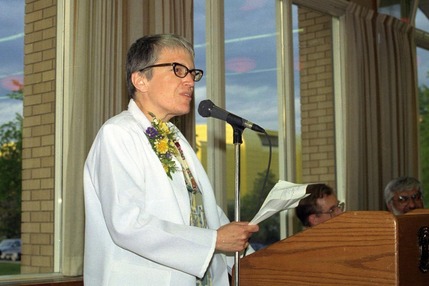
Agnes Herzberg died in Kingston, Ontario on June 2, 2026, at the age of 87. She made wide-ranging and remarkable contributions as a researcher, a promoter of statistics, science and public policy, a patron of the arts, and in professional service. In 1991-92 she served as the Statistical Society of Canada’s first female president.
Agnes Margaret Herzberg was born on December 12, 1938 in Saskatoon, Saskatchewan. Her parents were Gerhard Herzberg and Luise Oettinger, who had emigrated to Canada from Germany in 1935 to escape Nazi persecution. Both were physicists with PhDs and Gerhard became a professor at University of Saskatchewan. He and Luise had two children; Agnes’s brother, Paul (1936-2015), became a professor at York University in Toronto. In 1948 the family moved to Ottawa when Gerhard was appointed to the National Research Council of Canada (NRC), where he continued working until he died. In 1971 he won the Nobel Prize in Chemistry for his work in spectroscopy.
Following high school in Ottawa, Agnes enrolled at Queen’s University, graduating with a major in mathematics and minors in economics and political science. This was followed by graduate work at University of Saskatchewan where, in 1966, she received her PhD under the supervision of Norman Shklov. Her thesis was on response surfaces and rotatable designs, and several papers from it were published in The Annals of Mathematical Statistics. Experimental design remained a major area of research for her during her career.
In February 1966 Agnes, who had been awarded an NRC Overseas Fellowship for postdoctoral studies under David Cox, went to the UK. Cox was then at Birkbeck College in the University of London but in September 1966 he moved to the Department of Mathematics at Imperial College London (ICL) as Professor of Statistics and Agnes accompanied him. In March 1968, ICL offered her a Lecturer position in the Department, where she remained until 1988. As she described in a 2012 interview for Liaison, “Professor Cox was like a magnet, and many visitors came …” They included statisticians from all over the world, and Agnes forged collaborations with many of them, including David Andrews, Peter Bickel, Norman Draper and Valerii Fedorov.
Beyond her experimental design work, a particularly notable achievement of Agnes at ICL was her 1985 book with David Andrews, entitled Data: A Collection of Problems from Many Fields for the Student and Research Worker. The book provided data sets and background on their source; the data sets have been widely cited and used for teaching and for research on statistical methodology.
In 1988 Agnes returned to Canada to take up a position in the Department of Mathematics and Statistics at Queen’s University; upon retirement in 2004 she was designated Professor Emerita. While at Queen’s she continued working in design but also found inspiration from mathematics colleagues. One of her notable publications was a 2007 paper with Ram Murty on the mathematics of Sudoku: “Sudoku squares and chromatic polynomials.”
Agnes was passionate about the importance of statistics to science, society and the public good. For many years she organized invited sessions at SSC meetings with physicists, chemists and environmental scientists as speakers. In 1992, Queen’s University acquired Herstmonceux Castle in England through a donation, and Agnes had the inspiration for a conference at the castle on Statistics, Science and Public Policy (SSPP). In April 1996 Agnes organized the first of what would become an annual series of meetings at Herstmonceux (except for two occasions at Queen’s). Participants included statisticians, scientists, doctors and historians, but also journalists, high-ranking public servants, diplomats, high court judges, and legislators (including the Speaker in Canada’s House of Commons). Nobel laureates, ex university presidents and heads of scientific agencies were often present. For three days they would discuss pressing issues related to the environment, governance and public policy, international relations, security, health and education. Agnes arranged everything: the fundraising, the venue and accommodation, the program, and the editing and publishing of the proceedings for each meeting.
Agnes was a lover of classical music. When organizing the 1996 SSPP conference she decided to have an evening of music. That first year the performers were a small company of opera singers recommended by the head of the Castle; they were wonderful and reappeared at two subsequent conferences. A frequent performer in subsequent years was Angela Hewitt, the famous Canadian pianist. A friend had taught Miss Hewitt at University of Ottawa and agreed to forward a letter to her from Agnes. Thus was born a deep and enduring friendship; Agnes was listening to one of Angela Hewitt’s recordings of Mozart when she died. Another musician invited to perform at the music evenings was Gerald Finley, the famous Canadian baritone; like Agnes and Angela Hewitt, he studied in Ottawa. Around 2012 Agnes commissioned a chamber opera, ultimately named The Pencil Salesman, for the Westben Arts Festival in Campbellford, Ontario. It was created by Westben’s artistic director Brian Finley, a cousin of Gerald Finley, based on an outline written by Agnes. It had its world premiere at the Westben Arts Festival Theatre on June 25, 2016, with an international cast.
Agnes also had a strong commitment to service, which she viewed both as a duty and an honour. In addition to roles in the SSC, she served on the Royal Statistical Society’s council, NSERC’s Grant Selection Committee for the statistical sciences, and the University of Saskatchewan Senate. She was an associate editor for Biometrika, The Annals of Statistics, Journal of Statistical Planning and Inference and Canadian Journal of Statistics. From 1980 to 2006 she served as Editor of the International Statistical Institute’s Short Book Reviews. Agnes was a tireless promoter of books on statistics and during this period around 2,500 books were reviewed, and another 10,000 books were listed. She also recorded interviews with famous early statisticians such as Frank Yates, and she and David Hand edited a collection of David Cox’s papers.
Agnes received numerous honours during her lifetime. They included fellowships in the American Statistical Association, the Institute of Mathematical Statistics, and the American Association for the Advancement of Science. In 2008 she was made a Specially Elected Fellow of The Royal Society of Canada. She was awarded the International Statistical Institute’s Henri Willem Methorst Medal for service and in 1999 was the first female winner of the SSC’s Distinguished Service Award. In 2007 the SSC named her an Honorary Member. In 2014 she won the SSC’s Lise Manchester Award “for bringing together statisticians, scientists, politicians and public servants from Canada and around the world annually since 1996 to tackle problems at the intersection of statistics, science and public policy… creating a network of experts to discuss current and emerging issues of topical interest and improve public policy to deal with them”.
Agnes was unique, and her friends treasured this uniqueness. She had firm opinions on matters both social and professional; she was not confrontational, but when faced with a contrary opinion she could be heard to exclaim “Really?” Some views were “old school”: one that her male friends fondly adhered to was the wearing of a tie in certain settings. On her retirement from Queen’s in 2004, six friends at University of Waterloo went to Kingston wearing dress shirts and pink ties (official UW Math Faculty regalia). Agnes did use email but for correspondence preferred handwritten notes; at the SSPP conferences she advised (and in early meetings, insisted) that presentations be verbal and not based on slides.
Agnes had a special gift for staying in touch with friends, sometimes via correspondence but often by phone: a large number had regular calls with her, ranging from weekly to monthly. She struck up friendships in myriad ways. For statisticians many began when they were visitors or students in her university departments; she would take them under her wing and show them their new environs. Her circle of friends went far beyond statisticians and other academic colleagues, from children of statisticians to taxi, bus and limousine drivers, hairdressers and shopkeepers. She was close friends with musicians and was generous in supporting their artistic endeavours. Once she had a sense of someone’s interests, they could expect to receive occasional books from her. She loved donuts and was known to give them to favourite bus drivers.
Agnes Herzberg was a major contributor to the statistical sciences and to many other facets of scientific and cultural life in Canada and internationally. For this and for her friendship and loyalty to so many, she will be greatly missed but never forgotten.