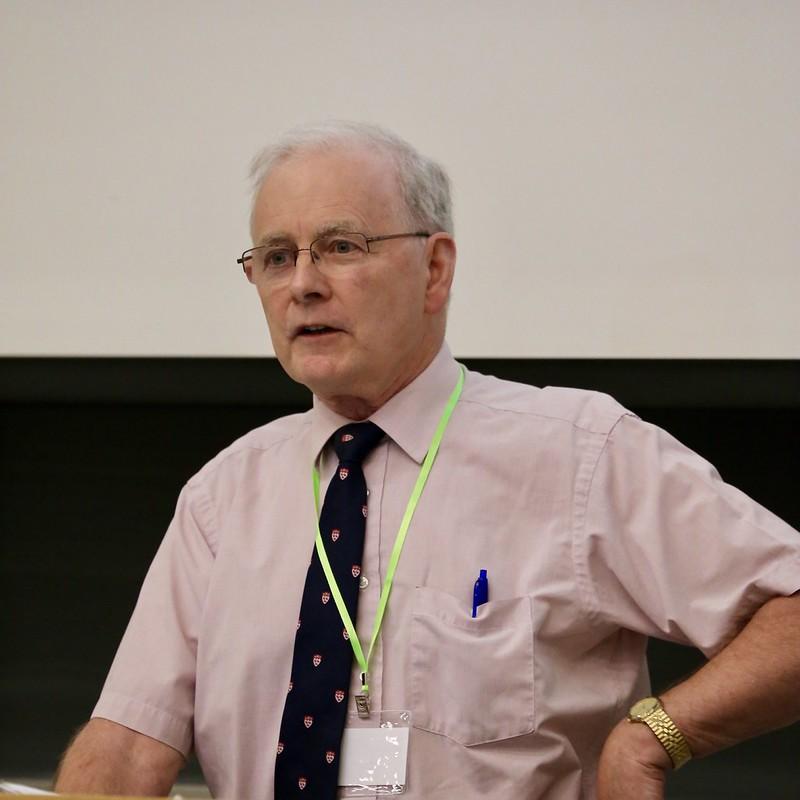
James A. Hanley, professor emeritus of biostatistics at McGill University, has been awarded the SSC Distinguished Educator Award.
Born in Ireland, James completed his bachelor's and master's degrees in mathematics and statistics at the National University of Ireland in Cork, before pursuing his doctoral studies at the University of Waterloo. After completing his PhD, he worked in the United States, first at the State University of New York (SUNY) in Buffalo, then at Harvard. He then returned to Canada in 1980 as a professor in what was then the Department of Epidemiology and Health at McGill University, where he remained until his retirement in 2023. He continues to be active and publishing articles, notably in statistics education and on the history of statistics.
James is a prolific researcher whose work has had an enormous impact. His remarkable contributions to biostatistics and epidemiology were recognized in 2016 with the SSC Award for Applied and Collaborative Impact, and he was named an honorary member of the Society in 2024. He has also received the Canadian Society for Epidemiology and Biostatistics (CSEB) Award of Excellence for Lifetime Achievement. As a detailed biography of James has already been published in Liaison (vol. 38, no. 4 and vol. 30, no. 3), this article focuses on his contributions to statistics education.
Across his career, James has approached teaching with a strong student focus and, through his use of real data, integration of active learning, and emphasis on conceptual understanding, he has been consistently applying evidence based best practices in statistics education. His former students and colleagues shared the profound impact James had on their respective careers in their letters of support. His innovative teaching style, described as original and extremely effective, stemmed from his boundless enthusiasm and ability to captivate his audience and to “bring statistics to life.” He usually began his lessons by bringing in a clipping from the Montreal Gazette or a newly published scientific paper, which he used as an introduction to a statistical concept or inference method. By relating biostatistics to everyday problems, and constantly renewing his examples, he was able to engage his students and motivate them to understand the “why” behind the tools he taught. To ensure their understanding, he also had them perform all basic statistical calculations manually so they could understand what was going on behind the scenes and deepen their understanding of software outputs. James encouraged critical thinking through authentic assessment by having his students review the methodology of articles. Active participation was also an integral part of James's classes, whether through data collection or classroom discussions with practitioners invited to share their experiences.
James's passion for teaching is contagious, and he has inspired numerous students. His mentorship of students other than those under his direct supervision is also remarkable: his door was always open for questions, he shows genuine interest in any student work, and he coauthored numerous popular science articles with students, often in response to a question they asked for clarification.
At McGill University, James served twice as director of graduate studies during a period of significant growth for the department and led the 2006–2008 curriculum redesigns with Erica Moodie that lead to the creation of the biostatistics PhD. He developed two required courses for the latter and also provided valuable assistance to his colleagues in the development and refinement of new course. He taught nearly 60 courses to generations of students in biostatistics, epidemiology, and medicine, sometimes as a co-instructor. His excellence in teaching has been widely recognized: James has received the Teaching Excellence Award from the student association of the Department of Epidemiology, Biostatistics, and Health 6 times, more than any other professor. He is also the recipient of the 2011 McGill President's Award for Teaching Excellence for full professors.
Among two of James’s most famous publications are his articles on the interpretation of receiver operating characteristics, coauthored with Barbara McNeil and published in Radiology in 1982–1983; these remain required reading in clinical epidemiology education. He has also written, often in collaboration with students, “translational” articles aimed at explaining statistical topics: these include presentations of generalized estimating equations (cited more than 2,500 times), statistical paradoxes, and screening trials, among other topics. In addition to highlighting pitfalls to avoid when applying these methods, the examples used in these articles make it possible to teach complex methods using intuitive examples with clear explanations. A remarkable quality of these publications, highlighted by many of James's colleagues, is that they remain relevant reading today, sometimes decades after their publication, and have educated generations of researchers and clinicians.
James has long been passionate about teaching and collects and curates examples and data for teaching purposes, ranging from the survival of Oscar winners to Titanic survivors, to measuring the depth of the ocean. This material, available on his personal website, has also been shared through a multitude of articles published in Teaching Statistics, American Statistician, and the Journal of Statistics and Data Science Education, among other venues. He has also written several short essays in Significance and Accromath aimed at a more general audience. His 40 or so publications related to pedagogy and the teaching of (bio)statistics have had an international impact, and James continues to pass on his knowledge (e.g., nine tutorials have been published since his retirement!).
Citation for the award:
To James Hanley for his leadership in advancing biostatistics and epidemiology education at McGill University and around the world; for his landmark expository papers that illuminate statistical methods in the health sciences and beyond; for his outstanding commitment to mentoring students both inside and outside the classroom; and for his sustained and innovative teaching of statistical concepts through real‐life problems and historical data, widely shared through his scholarly work.
This text was written by Léo Belzile building on testimonials and support letters from Robert Platt, Andrea Benedetti, Josée Dupuis, Gilles Paradis, Elizabeth Turner, Jennifer Hutcheon, and Carine Bellera.